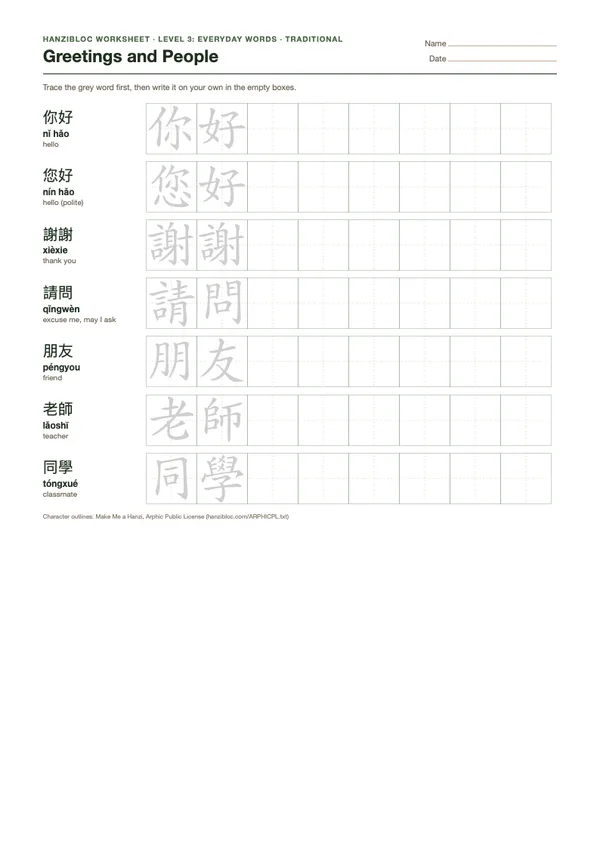
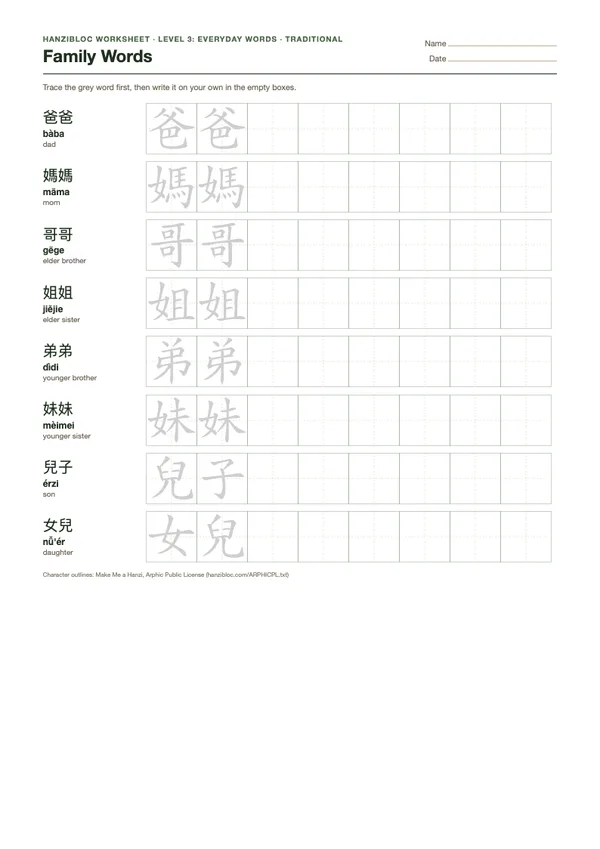
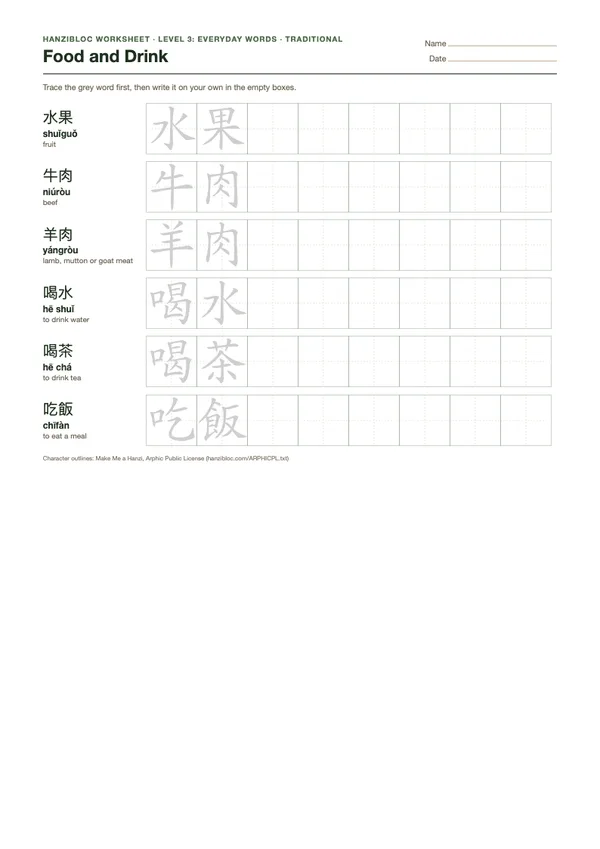
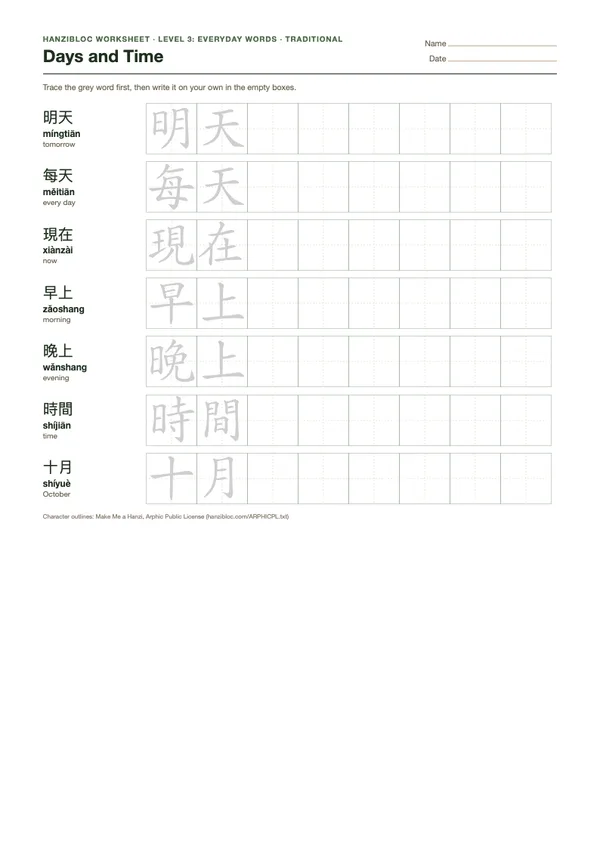
Level 3 · 7 words · Free PDF
Everyday Actions: Chinese Writing Worksheet
Many Chinese verbs are a verb plus what it acts on: 洗手 is "wash hands" and 開門 is "open door". Compare 開門 and 關門 (close the door) to see how one character changes the meaning.
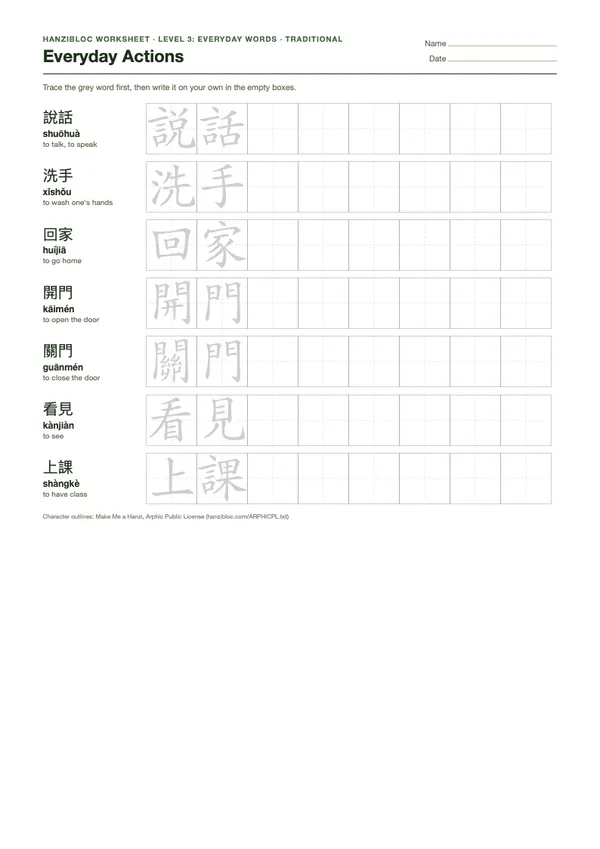
Traditional
Used in Taiwan, Hong Kong and Macau.
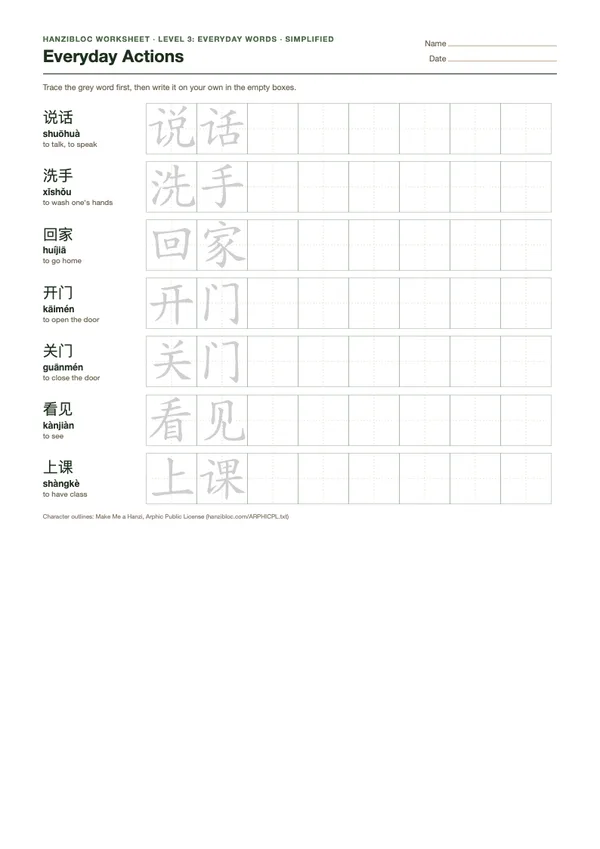
Simplified
Used in mainland China and Singapore.
What’s on this worksheet
| Word (Traditional / Simplified) | Pinyin | Meaning |
|---|---|---|
| 說話 / 说话 | shuōhuà | to talk, to speak |
| 洗手 | xǐshǒu | to wash one's hands |
| 回家 | huíjiā | to go home |
| 開門 / 开门 | kāimén | to open the door |
| 關門 / 关门 | guānmén | to close the door |
| 看見 / 看见 | kànjiàn | to see |
| 上課 / 上课 | shàngkè | to have class |
Pinyin follows the Hanyu Pinyin standard used in mainland China. In Taiwan, some syllables marked here with a neutral tone are often read with their full tone.
How to use it
- Print the sheet in the character set you are learning.
- Say the word out loud, then trace the grey word slowly.
- Write it on your own in the empty boxes, keeping each character inside its square. The dashed lines help you place each part.
- Check your writing against the grey word, and try again tomorrow. Short, regular practice works better than one long session.
The worksheets don’t show stroke order. That is easier to learn by watching each stroke being drawn. In the Hanzibloc app you write every character stroke by stroke on your phone, and the app checks each stroke as you go.